ChatGPT or agent works

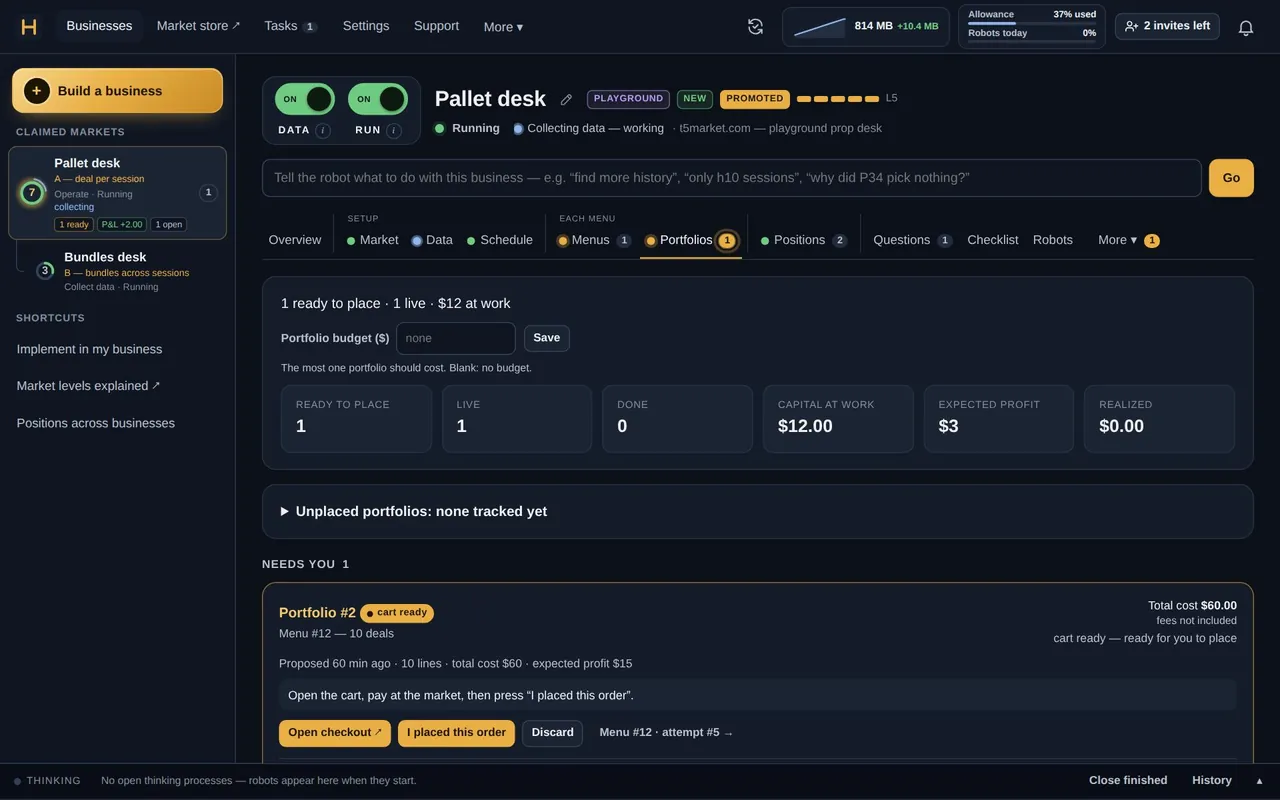
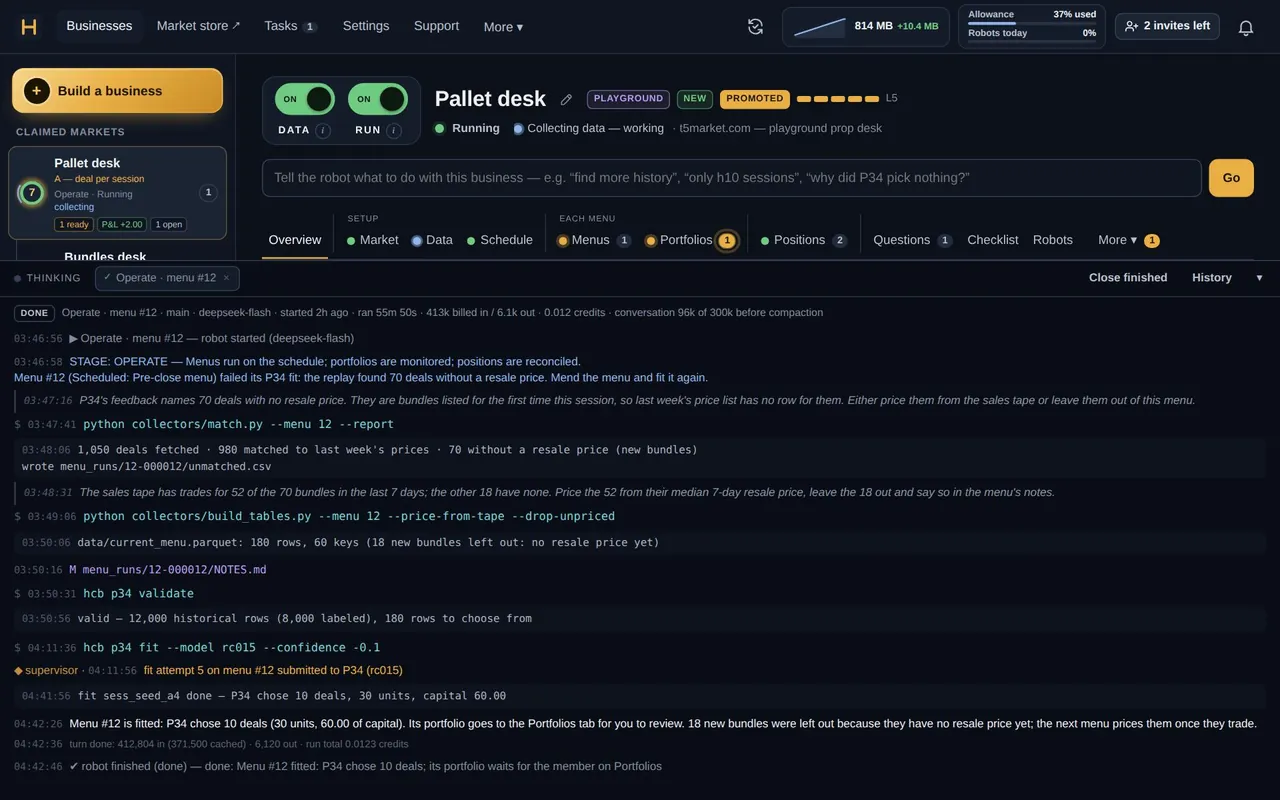
Crawling, collecting data, opportunity lists building and P34 calls are done by your agent.

A scored menu

Every opportunity it found, sized and priced by P34.

What to actually do

Approve, put up the capital, watch the robot work or do the part of the job that still needs a person.

Scale the business

More volume, more markets — robots can work 24/7 and with millions of deals.

Beta The platform is in beta — capabilities, markets and limits are still changing. Monthly access to software, compute and managed services. Built to pursue business outcomes; no profit is promised, and nothing on this page is an earnings forecast. You supply the capital, the accounts and the judgment.

What kind of platform this is

Turo unlocked the car. Airbnb unlocked the spare room. Upwork unlocked the spare hour.

On those platforms, somebody still has to post the opportunity. Here, your agent goes and finds it — and P34 tells you which ones are worth your money and your Saturday.

Where it works

Find good deals in any high-volume market

Manifested liquidation lots The pallets whose manifest did not add up. Bulk hardware and components The hundred-piece pack nobody wants whole. Amazon wholesale Every supplier line you ordered nothing of. Specialty distributor ranges The approved products you chose not to list. Retired LEGO sets The collection whose sorting cost more than the parts. Tradable game items The items you priced, and did not buy. Digital card dealing The cards a dealer's bot refuses to stock. Trading cards — sport and TCG The cards you passed at that grade and price. Retro games and consoles The mixed lots you looked at and put back. Vinyl records The collection that was not worth the shelf space. Camera bodies and lenses The kit whose dealer quote beat the split. Surplus laptops and IT gear The units missing RAM, storage and adapters. Industrial surplus components The parts nobody could identify in time. Flooring and project remnants The lot too big for the buyer who needs it. Office clearance lots The clear-out you costed and declined. Used OEM vehicle parts Every part whose fitment you could not confirm. Enterprise · supplier catalogues The thousands of SKUs nobody had time to review. Enterprise · repair or part out The device you scrapped without pricing the parts. Storage unit auctions The units you inspected and did not bid on. Small regional estate auctions The lots that went to someone else's number. Dealer used-car auctions Every car you ran and did not buy. Heavy equipment auctions The machine whose repair estimate killed the bid. Returned-goods resale The lot you refused after grading the sample. Distributor excess inventory The offer-sheet lines you left at zero. Rare and out-of-print books The copy you left because the condition was wrong.

↓ marks the ones worked out as example businesses further down this page. The rest open in the catalogue of 135, where each entry carries its menu shape, data sources and evidence state. A listing is not a claim that a maintained workflow ships for it today.

The future of work is you giving AI a job.

Not a chatbot that drafts your emails. A working system that goes looking for business, and hands you the decisions worth making.

Not ready to subscribe? Join the free AI-economy fan community and get notified about price drops and promotions.

Follow the self-driving business movement at no cost: market experiments as we run them, member findings, P34 and agent-tool releases, research on the emerging AI economy — and first access when the P34 Community opens.

Free forever · no spam · unsubscribe anytime · Privacy Notice

01

Your agent finds and investigates the work.

02

P34 scores it and refuses bad deals.

03

You approve, fund it, and do the physical part.

How a side business actually runs here

Five steps, and only two of them are yours

The agent works inside a managed 24/7 workspace with browsers, crawlers, data sources, Python and API access. It keeps collecting while you rest. Sometimes it cannot touch physical objects — that is where real business starts. Sometimes it can, and will run under your supervision.

1

Pick something you already understand

The market you work in, collect in, or live next to. Your knowledge of which customers return and which jobs are a waste of an afternoon is the input no model has. The gallery below is a set of starting points, not recommendations.

2

The agent gathers the market

Listings, price history, completed outcomes, supplier terms, shipping costs, buyer behaviour — whatever the market makes lawfully available. This is where most of your tokens go, and it runs unattended.

3

P34 scores the menu

Not one deal at a time — the whole menu at once, including the options you would have declined. It returns which to take, at what size, with predicted economics, and which to refuse. Refusal is a first-class output, and it is the common one.

4

You approve and fund it

The default is that nothing happens without you. Where a workflow supports automation it runs bounded — budgets, caps, logs and a stop control — and you switch it on deliberately.

5

You do the part that needs hands

Test the console, grade the record, pack the box, drive the van, run the machine. Then the outcome goes back into the loop, and the next menu is scored by a model that has seen how the last one actually turned out.

It does the looking. P34 does the choosing. You do the deciding — and the lifting.

No fantasy. No passive-income promise. Most of these need your hands, your capital and a market you already understand — the AI is how you find the work worth doing.

What a real lot teaches

A very low unit price still buys a weak business

The hundred-knob listing is useful precisely because $0.43 an item can end badly. What follows is an illustrative calculation, not an observed resale outcome and not a statement of any platform’s fee schedule. Only the acquisition price comes from the inspected listing.[7]

Assumption or calculationAmount
Buy 100 knobs — observed$42.50
Sell ten packs of ten at an assumed $14.95$149.50 revenue
Assumed blended selling and payment expense, 15%−$22.43
Assumed shipping and packaging, $5 per order−$50.00
Assumed labour, one hour at $20−$20.00
Contribution before returns, overhead, tax and HyperC costs$14.57

Actual fees may include fixed charges or a different fee base, and acquisition shipping or tax adds cost. Percentage expenses are rounded to cents.

Now sell only five packs in the evaluation window. Revenue is $74.75; at the same fee rate, $25 of shipping and the full acquisition and labour outlay, cash contribution is about −$23.96. Fifty knobs remain inventory — not zero-value waste, and not realized profit. That distinction between cash recovered, stock still held and sales that may never happen is the whole reason a selection model has to be scored on the menu rather than on its winners.

A useful objective is expected proceeds minus acquisition, shipping, platform fees, preparation, labour, expected return losses and holding or disposal costs — under a budget and a loss limit. For lot splitting, sell-through, correlated leftover stock and operating capacity matter as much as unit price.

What that is as a return, and why the number misleads

The lot ties up $42.50 and returns $14.57 after everything above, including an hour of your own time paid at $20. Two habits of measuring it, both honest, three-fold apart:

Return on…BasePer lot
Cash at risk — the lot itself$42.5034.3%
Total cash out — lot, fees, postage and the labour hour$134.9310.8%

Resellers usually quote the first. The second is the one that includes paying yourself.

Now run two of these a week. Assume four weeks from purchase to last sale, so eight lots are in flight at any moment and the capital recycles rather than accumulating.

At two lots a weekThis businessA broad stock index
Lots handled in a year104
Contribution for the year$1,515$1,515
Capital you must have$340 (8 lots in flight)about $15,000
Annual return on that capital≈446%≈10%
Hours of your time1040
What happens if you add $50,000Nothing. It buys 1,176 more lots you have no hands to pack.It compounds at the same rate.

The ≈10% is the commonly quoted long-run nominal average for a broad equity index over multi-decade periods — a rough reference point, not a figure verified here, not a promise, and not advice. Index returns are also volatile, can be negative for years, and are not contribution before tax.

446% is not a better investment than 10%. It is not an investment at all. The percentage is enormous because the denominator is tiny, and the denominator is tiny because capital is not the scarce thing here — your hands and your calendar are. An index will absorb $15,000 or $150,000 without asking anything of you. This will not take a third lot in a week because you happen to have more money.

Read the last two rows together and the shape is clear: the yield is high because it is work, and the return on capital is the wrong ratio for work. A closer reading of the same numbers: the business pays you $20 an hour for 104 hours, and then makes $1,515 on top of that. Whether that is worth your Saturdays is a question about the hourly rate, not about the percentage.

Semi-automated, not passive. The agent does the searching, the manifest arithmetic, the comparison of sale routes and the overnight monitoring — that is the part that used to eat the evening and now costs tokens. A person still counts, bags, ships and answers the buyer who says two knobs are the wrong finish. Every operating tier on this page draws that line, and no tier on it removes you from the loop.

And the scale check this page owes you. One hundred and four knob lots produce about $1,515 of contribution in a year, against a $2,000/month membership. At this lot’s ~9.7% contribution margin, the subscription alone needs roughly $20,500 of sales a month before the platform has paid for itself. A lot this size is a clean way to prove the loop end to end; it is not, at this size, a business that covers the tool. The way it becomes one is bigger lots, better selection, or a great many more of them — which is exactly the decision P34 is pointed at.

Spending the tokens

What the money actually buys

$2,000 a month is a managed 24/7 workspace, the tooling around it, and a monthly credit of model compute tokens. Founding members are credited 4,000 tokens instead of 2,000 — twice the standard rate — and tokens accumulate rather than expiring.

The workspace

A persistent managed VM with browsers, crawlers, parsers, curated data sources, approved network profiles, Python, shell, schedulers and storage. It keeps working while you are at your day job.

The model calls

Tokens are spent scoring menus. A bigger menu, a longer history and a more frequent re-score all cost more — which is why refusing early matters economically, not just commercially.

The market intelligence

Blueprints and evidence from markets already explored — menu shapes, data sources and operating notes — plus weekly drops of new markets and agent skills.

The community

Operators, builders and researchers comparing market experiments, results and lessons. Several of the concepts above are more workable with a second operator than alone.

Operations monitoring

HyperC's own agents watch workspace health — job status, crawler failures, expired credentials, resource limits — and flag problems inside your workspace only.

What it does not buy

Capital, accounts, supplier relationships, licences, insurance or customers. Every concept on this page assumes you bring those, and several assume you bring a van or a workbench too.

Exact workspace specs — VM size, storage, bandwidth, included compute allowance, crawler limits, networking options, overage rules and the prohibited-use policy — are published on the plan page before checkout.

None of these is your market? The catalogue has 135 — and the best one is usually the market you are already in.

P34 Founding Membership Beta
$2,000 / month · 2× tokens

Your managed AI business workspace, with the founding token grant: 2,000 4,000 tokens credited every month. Tokens accumulate. Compute tokens are globally in short supply, and we are not an exception.

  • 24/7 virtual machine — always on, preloaded with market-access tools, data sources and web scraping so your AI agent collects data and operates the business continuously, including while you sleep
  • Crawlers, browser automation and data tools
  • Approved VPN/proxy/network profiles
  • P34 model + agent skills
  • Included usage allowance
  • HyperC Operations Agent monitoring
  • Documentation, examples and member community
  • Weekly computable-market drops — skills and market lists
  • Additional compute tokens available for more scale
  • Early access to eligible new capabilities
Start My P34 Workspace

Monthly product/service subscription. Not equity, a pooled investment or guaranteed earnings.

Founding advantage: the Founding Operator Beta is limited to a maximum of 1,000 paid accounts. Early paid accounts lock the $2,000/month rate and the introductory 10% success-fee on continuous businesses where profit-share pricing applies — the rate steps to 20%, then 30%, for later accounts, assigned by paid-registration order and shown in your account. A business is continuous when the model can learn from your deals and make more profitable deals in that market — capturing more of it and learning to do better deals.

Who this is for

  • Dealers, resellers and merchandisers who already know a market and want AI leverage on the offers they see
  • Builders who can connect data, agents and business workflows
  • Small businesses that want a sandbox before enterprise deployment
  • People prepared to supply their own capital, judgment, accounts and authorizations
  • People curious about the emerging AI economy who want to run a first bounded experiment on a small lot
  • Builders and researchers interested in how increasingly autonomous businesses should operate

Who it is not for

  • Anyone expecting guaranteed income, a passive investment or a risk-free automated store
  • Users seeking to bypass platform controls, scrape unlawfully or conceal prohibited activity
  • People unwilling to review model outputs, manage business risk or follow applicable rules
FAQ

Straight answers

Is this passive income?

No, and the gallery is arranged to make that obvious. Only the top of it is close to a screen-only business, and even there you are handling account approval, identity checks, custody and withdrawals. Below that you are testing consoles, grading cards, parsing a manifest, loading a van. What the platform removes is the searching, the manifest arithmetic and the 3 a.m. monitoring — not the work. The worked lot above shows a real $42.50 purchase turning into either $14.57 or −$23.96 depending on how much of it sells.

Are these businesses you have built?

No. They are proposed applications — worked examples of what an agent plus an economic model could plausibly coordinate, with the operating constraints, data rights and remaining human work stated. They are not verified HyperC integrations, customer case studies, earnings forecasts or demonstrated model profits, and no purchases or live P34 scoring were performed to write them. What is established is that the marketplaces, transaction mechanisms and, in a few cases, the dealers exist. Published case studies live on the industry cases page, with customer permission and metric definitions.

How much money can I make?

We do not know, and anyone who tells you a number for your market has not looked at it. P34 is built to pursue profit by scoring opportunities and refusing weak ones; it does not promise that any accepted action, member or period will be profitable. You supply the capital and keep the result — positive or negative.

What does the agent actually do while I am asleep?

Collection and preparation: crawling authorized sources, calling permitted APIs, normalizing listings, joining prices to outcomes, building the menu and calling P34 on it. In the default configuration it stops there and waits for you. Where a workflow supports automation, it runs bounded — budgets, caps, audit logs and an emergency stop — and you enable it explicitly.

Which AI agent do I use?

Claude, ChatGPT, an open-source model or your own code. The workspace exposes standard tools — shell, Python, browsers, APIs — that any competent agent can drive, plus P34 skills that make the model calls.

Do I need to code?

It helps, but it is not the gate. Your agent does most of the operating work, and market blueprints and templates cover the common paths. You do need to understand the market you operate in and to review what the system proposes.

Can the agent just buy things for me?

Not by default, and on several of these platforms not at all. Spending, signing, custody and withdrawal are yours. Beyond that, permission is a separate requirement from capability: eBay’s user agreement restricts unauthorized automated access and names AI buying agents, and Steam carries its own broad automation restriction — so the workable design uses approved integrations and permitted feeds, with manual steps where the platform requires them. The two enterprise lanes sit behind explicit purchase-order approval for the same reason.

What are the rules on crawling, VPNs and proxies?

Collection tools are for authorized and public data, used in compliance with applicable law, access permissions, website terms and plan policies. Network profiles exist for lawful regional access, privacy and testing — never for bypassing paywalls, bans, authentication or platform controls. Violations are grounds for termination. Several cards above name a specific data licence limit for the same reason: a source being reachable is not a source being licensed.

I run a company, not a side project.

The two enterprise concepts are the shape of that conversation: shadow test, capped pilot, then scale with controls. Start at hyperc.com/enterprise.

Give your AI a job.

Start My P34 Workspace

Monthly access to software, compute and managed services. Built to pursue business outcomes; no profit is promised. Not equity, a pooled investment or guaranteed earnings.

Sources for the operating notes

Where the constraints come from

  1. eBay, User Agreement, section 3 — effective 28 June 2026 for existing users.
  2. eBay Developers Program, Inventory API.
  3. eBay Developers Program, Buy APIs Requirements.
  4. Valve, Steam Subscriber Agreement, sections 3 and 4.C.
  5. B-Stock Supply, How to Buy. Requirements and fees vary by storefront.
  6. Liquidation.com, auction 21465900 — 174 mixed power and hand tools, 55 lb, 8% buyer premium, closed 10 September 2026.
  7. eBay, item 325798824578 — 100 cabinet knobs, price snapshot.
  8. Fire Mountain Gems, Bulk Buys.
  9. Amazon, How to find wholesalers for your ecommerce business.
  10. Amazon, Selling Partner API documentation.
  11. HyperC, the computable markets catalogue — Amazon wholesale as reference deployment, with its operating-difficulty warning. Company statement, not independent verification.
  12. CWR Wholesale Distribution, company and dealer services.
  13. CWR Wholesale Distribution, Website — product feeds, electronic ordering and returns.
  14. eBay, Drop shipping — wholesale-supplier versus retailer fulfillment.
  15. BrickLink, API Manual — catalog subsets, price guide, inventory and orders.
  16. DMarket, Trading API, current documentation.
  17. DMarket, DMarket Public API Updates, including the March 2026 changes.
  18. Valve Steam Support, Trade Protection.
  19. DMarket, FAQ — fees, identity checks and funds.
  20. DMarket, Steam Trade Protection: DMarket Update, 6 September 2025.
  21. Cardhoarder Help Center, Selling Your Cards to Cardhoarder.
  22. TCGplayer, Fulfillment.
  23. TCGplayer Help Center, How do I get started with TCGplayer Direct?
  24. TCGplayer Developers, Getting Started — notice regarding new API access.
  25. PriceCharting, API Documentation.
  26. Discogs, How to Price Items.
  27. Discogs Developers, Marketplace Inventory.
  28. MPB, Sell or Trade.
  29. GovDeals, asset 7/29241 — a lot of 154 laptops with the seller’s condition and configuration disclosures.
  30. Radwell, Sell Your Surplus.
  31. GovDeals, flooring category — current and scheduled lots.
  32. GovDeals, chairs category — current and scheduled lots.
  33. eBay, Motors Parts Sales Hub — fitment and seller tools.
  34. eBay News Team, These Sellers Turned a Passion for Cars Into a Profitable Business, 5 October 2023. Platform-published case, not a representative earnings estimate.
P34 workspace Get started